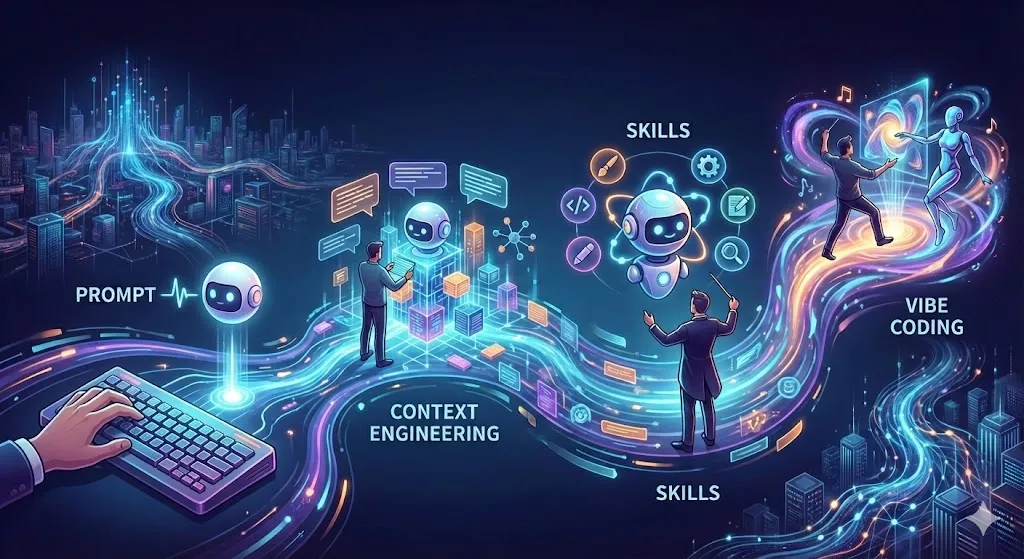
From Prompt to Context Engineering to Skills: The Evolution of AI Interaction Paradigms and the Rise of Vibe Coding
Introduction: Three Revolutions in AI Interaction
At the end of 2022, the sudden arrival of ChatGPT marked the beginning of a new era for artificial intelligence. In just over two years, the way we interact with AI has undergone three profound paradigm shifts:
The first revolution: Prompt Engineering — we learned how to converse with AI, using carefully designed prompts to guide model output.
The second revolution: Context Engineering — we realized that AI’s capabilities depend not only on the prompt itself but also, and more importantly, on the context environment provided to it. The introduction of RAG, memory systems, and external knowledge bases turned AI from a “closed-book exam” into an “open-book exam.”
The third revolution: Skills & Agentic AI — AI no longer merely answers questions passively; it can proactively call tools, execute actions, and collaborate with other agents, becoming a true “digital worker.”
At the same time, a new programming paradigm is quietly emerging — Vibe Coding — and it is redefining the collaborative relationship between humans and AI in software development.
This article will take you through this entire evolution. Whether you are a beginner just getting started with AI or a technical practitioner hoping to understand the underlying logic more deeply, you can gain a more systematic understanding.
Chapter 1: Prompt Engineering — The Art of Conversing with AI
1.1 What Is Prompt Engineering?
Prompt Engineering is the technique of designing and optimizing input prompts to guide large language models (LLMs) toward more accurate and useful output. It is the most fundamental and intuitive way to interact with AI — you input text, and the AI returns text.
But prompt engineering is far more than just “asking questions.” As 2025 best practices emphasize: “Specific prompts are better prompts.”
A bad example:
"解释气候变化"A good example:
"为高中生撰写一段关于气候变化的三段式总结,使用项目符号,
保持中立语气,控制在 300 字以内。"
1.2 Core Techniques
Zero-Shot Prompting
Present a task directly to the model without providing any examples. This is the simplest approach and is suitable for tasks where the model already possesses the relevant knowledge.
将以下英文翻译成中文:
"The quick brown fox jumps over the lazy dog."
Few-Shot Prompting
Provide 3–5 high-quality examples so the model can learn the pattern and format. Research shows that this is one of the most effective ways to improve output quality.
将情感分类为正面、负面或中性。

示例 1:
文本:"这部电影太棒了!"
情感:正面

示例 2:
文本:"服务态度很差"
情感:负面

示例 3:
文本:"今天天气晴朗"
情感:中性

待分类文本:"这个产品完全不符合预期"
情感:
Chain-of-Thought (CoT)
Ask the model to show its reasoning process rather than give the answer directly. This is especially effective for math problems and logical reasoning.
问题:一个农场有 35 只鸡和 28 只兔子。农场主卖掉了一半的鸡和
三分之一的兔子。还剩多少只动物?

请一步一步思考:
The model will output:
1. 初始鸡的数量:35 只
2. 卖掉一半的鸡:35 ÷ 2 = 17.5,取整为 17 只
3. 剩余鸡:35 - 17 = 18 只
4. 初始兔子数量:28 只
5. 卖掉三分之一的兔子:28 ÷ 3 ≈ 9 只
6. 剩余兔子:28 - 9 = 19 只
7. 总共剩余:18 + 19 = 37 只
ReAct (Reasoning + Acting)
An advanced technique that combines reasoning with tool use. The model not only thinks but can also decide when to use external tools.
你需要搜索最新信息来回答用户问题。

问题:苹果公司今天的股价是多少?

思考:我需要搜索苹果的最新股价
行动:搜索 "Apple stock price today"
观察:[搜索结果:AAPL $182.50, +1.2%]
思考:我已经获得了股价信息
最终答案:苹果公司今天股价为 182.50 美元,上涨 1.2%
1.3 Frontier Techniques in 2025
Recursive Self-Improvement Prompting (RSIP)
Have AI critique and improve its own output, reaching higher quality through multiple rounds of iteration.
Process:
- Generate: Create an initial output.
- Critical evaluation: Have the model identify weaknesses using specific criteria.
- Improve: Generate an enhanced version based on the criticism.
Practice shows that this method can reduce revision cycles by about 60%.
Multi-Perspective Simulation (MPS)
Run a “virtual expert panel” within a single conversation, having the model analyze a problem from different angles.
请从以下三个角度分析这个商业决策:
1. 财务总监(关注成本与 ROI)
2. 技术总监(关注可行性与技术债务)
3. 市场总监(关注用户体验与竞争优势)

每个视角都需要:
- 阐述核心观点
- 提出潜在风险
- 给出具体建议

最后,请综合三个视角给出整体评估。
1.4 The Limitations of Prompt Engineering
Although prompt engineering is powerful, it has fundamental limitations:
-
Fragility: Small changes in input, system version updates, or even model randomness can cause output quality to fluctuate.
-
Limited Context: The model’s context window is finite and cannot process large amounts of external information.
-
No Real-Time Knowledge: The model can only rely on training data and cannot obtain the latest information.
-
No Action Capability: The model can only generate text and cannot perform actual actions.
These limitations gave rise to the next stage of evolution — Context Engineering.
Chapter 2: Context Engineering — Building AI’s Operating Environment
2.1 The Paradigm Shift from Prompt to Context
Context Engineering is a new discipline that emerged in 2024–2025. If Prompt Engineering is “writing good questions,” Context Engineering is “building a complete operating environment.”
Core definition:
Context Engineering is the systematic design and management of all the information provided to an LLM — including prompts, retrieval results, conversation history, metadata, and tool state — to control the model’s reasoning and output without modifying the model’s weights.
Simply put, Context Engineering = Prompt Engineering + RAG + memory management + tool state + environment configuration.
2.2 RAG: Retrieval-Augmented Generation
RAG (Retrieval-Augmented Generation) is a core component of Context Engineering. It solves the problem that LLMs cannot access private data or obtain real-time information.
RAG workflow:
用户查询 → 嵌入向量 → 向量数据库检索 → 获取 Top-K 相关文档
→ 将文档注入提示上下文 → LLM 生成回答
Practical application scenarios:
Scenario 1: Enterprise knowledge base Q&A
基于以下公司内部文档回答问题:
<documents>
[从向量数据库检索的相关文档片段]
</documents>

问题:我们的年假政策是什么?
请引用相关文档的具体章节并标注页码。
Scenario 2: Customer service bot
你是一个客服助手。以下是相关的产品文档和历史对话:
<context>
[产品手册片段]
[用户之前的工单记录]
[常见问题解答]
</context>

用户问题:我的订单什么时候能到?
订单号:#12345
2.3 The Technical Pillars of Context Engineering
1. Prompt Design
Dynamic prompt templates that assemble different prompts based on the user, task, and system state.
# 动态提示模板示例
def build_prompt(user_type, task, context):
    system_prompt = f"你是一个{user_type}专家助手。"
    user_prompt = f"任务:{task}\n\n上下文:{context}"
    return system_prompt + user_prompt
2. Context Composition
Modern AI systems need to compose multiple layers of context:
- Conversation history: maintain conversational coherence
- Retrieval results: inject external knowledge
- Current tool state: tell the AI which tools are available
- Agent goals and plans: track the state of long-running tasks
- User profile/preferences: personalization settings
context_stack = {
    "system_instructions": "你是一个研究助手...",
    "user_profile": {"role": "研究员", "expertise": "AI"},
    "conversation_history": [...],
    "retrieved_documents": [...],
    "available_tools": ["search", "calculator", "code_runner"],
    "current_task_state": {"step": 3, "goal": "完成报告"}
}
3. Memory Systems
Production-grade agents need a four-layer memory architecture:
| Memory type | Description | Technical implementation |
|---|---|---|
| Short-Term Memory (STM) | Short-term context of the current conversation | Sliding window, retaining the most recent N turns |
| Working Memory | Temporary state of the current task | Variable storage, cleared when the task is complete |
| Long-Term Memory (LTM) | User preferences, historical interactions | Persistent storage in a vector database |
| Episodic Memory | Memory of specific events/experiences | Structured storage with semantic retrieval |
2.4 Prompt Engineering vs Context Engineering
| Dimension | Prompt Engineering | Context Engineering |
|---|---|---|
| Focus | Wording and structure of the prompt | Design of the complete input environment |
| Scope | Single interaction | Multi-turn conversation + external systems |
| Technology stack | Natural language + templates | RAG + vector DB + memory systems |
| Goal | Optimize a single output | Shape sustained, reliable behavior |
| Use cases | Simple Q&A, content generation | Complex applications, production systems |
Key insight:
“Prompt Engineering optimizes the immediate output; Context Engineering governs all the context the model sees before inference, shaping sustained behavior in production systems.”
Chapter 3: Skills, Tool Use, and Agentic AI — From Speaking to Acting
3.1 Tool Calling: AI’s “Hands” and “Feet”
If Context Engineering gave AI “eyes” (to see external information), then Tool Use gives AI “hands” and “feet” (to perform actions).
Definition of tool calling:
Tool calling is the process by which an LLM decides to use external capabilities (running code, calling APIs, searching the web, operating databases) to complete tasks that the model cannot accomplish on its own.
Tool-calling decision flow:
1. 解析用户查询 → 理解用户想要什么
2. 映射意图到工具模式 → 对比可用工具描述
3. 决定是否需要工具 → 纯推理 vs 需要执行
4. 生成结构化工具调用 → JSON 格式的函数调用
5. 在外部执行工具 → Python/API/数据库查询
6. 将输出返回给 LLM → 工具执行结果
7. LLM 决定下一步 → 继续调用工具或直接回答
3.2 Function Calling in Practice
Example: A weather query agent
First, define the tool schema:
{
  "name": "get_weather",
  "description": "获取指定城市的当前天气",
  "parameters": {
    "type": "object",
    "properties": {
      "city": {
        "type": "string",
        "description": "城市名称,如 '北京'、'上海'"
      },
      "unit": {
        "type": "string",
        "enum": ["celsius", "fahrenheit"],
        "description": "温度单位"
      }
    },
    "required": ["city"]
  }
}
User input: “What’s the weather like in Beijing today?”
The LLM’s decision process:
思考:用户询问北京天气,我需要调用 get_weather 工具
工具调用:{"tool": "get_weather", "arguments": {"city": "北京", "unit": "celsius"}}
The backend executes the tool and returns:
{
  "temperature": 22,
  "condition": "晴朗",
  "humidity": "45%"
}
The LLM generates the final answer:
北京今天天气晴朗,气温 22°C,湿度 45%,是个出行的好天气!3.3 MCP: Model Context Protocol — AI’s “USB-C”
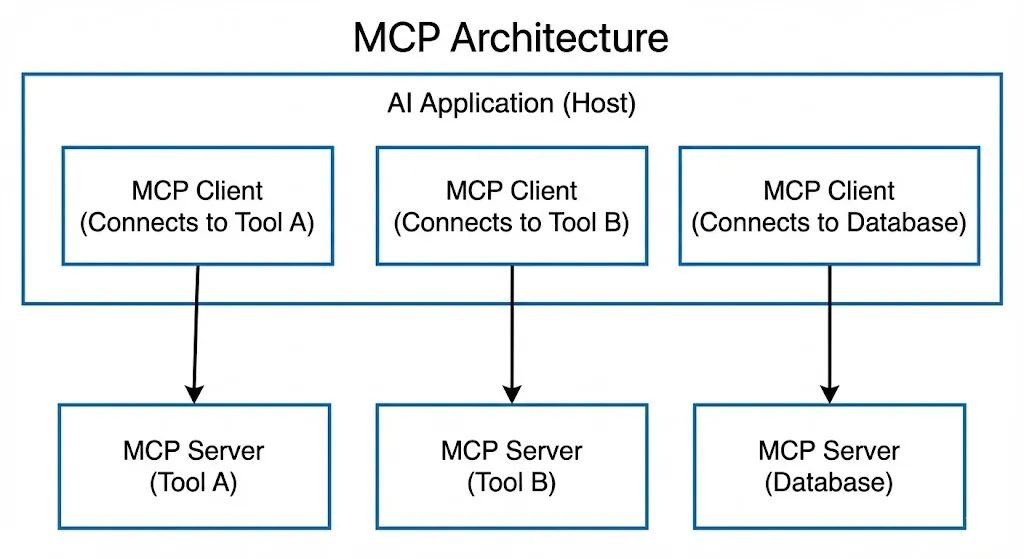
At the end of 2024, Anthropic introduced the MCP (Model Context Protocol), an open standard protocol intended to standardize how AI systems interact with external tools and data sources.
MCP’s core vision:
“Just as USB-C provides a universal connection for a variety of devices, MCP provides a unified interface for AI models to connect to different tools and data sources.”
MCP architecture:
MCP’s 2025 roadmap includes:
- Remote MCP connections: support for OAuth 2.0 authentication and authorization
- Distribution and discovery: package management, installation tooling, server registration
- Agent support: hierarchical agent systems, interactive workflows, streaming results
MCP is rapidly becoming an industry standard, much as the LSP (Language Server Protocol) did.
3.4 A2A: Agent-to-Agent Protocol — AI’s “Social Language”
If MCP is the universal interface between AI and tools, then A2A (Agent-to-Agent Protocol) is the universal language between AI and AI.
In April 2025, Google introduced the A2A protocol, an open standard intended to enable AI agents from different frameworks and different vendors to discover one another, negotiate tasks, and collaborate on complex workflows.
A2A’s five design principles:
- Embrace natural agent capabilities: do not force changes to how agents work
- Build on existing standards: use mature technologies such as HTTP and JSON-RPC
- Enterprise-grade security: built-in authentication, authorization, and encryption
- Support long-running tasks: asynchronous execution, status updates, and push notifications
- Modality-agnostic: support text, audio, video, and structured data
A2A’s core concepts:
| Component | Description |
|---|---|
| Agent Cards | JSON metadata files describing an agent’s capabilities, identity, and endpoints |
| Task Management | Task lifecycle management: initiation, status updates, completion notifications |
| Collaboration | Agents exchange context and negotiate how work will be executed |
| UX Negotiation | Negotiate content types and formats to adapt to different UI capabilities |
Practical application scenarios:
Recruiting workflow automation:
招聘经理 Agent → 发布招聘需求
       ↓
猎头 Agent A → 搜索候选人
       ↓
猎头 Agent B → 安排面试
       ↓
背景调查 Agent → 执行背景核查
       ↓
所有结果汇总 → 招聘经理 Agent
Each agent may come from a different vendor and use a different framework, but through the A2A protocol they can collaborate seamlessly.
3.5 Modern Agent Architecture
A production-grade AI agent can be formally defined as:
Agent := <Perception, Memory, Reasoning, Planning, Action, Feedback>Components in detail:
| Component | Function | Technical implementation |
|---|---|---|
| Perception | Receive input | Text parsing, API adapters, log reading |
| Memory | Store state | Vector DB, document storage, short-term context |
| Reasoning | Reasoning and decision-making | LLM reasoning + CoT/ReAct/ToT |
| Planning | Task planning | Task decomposition, tool selection, execution graph |
| Action | Execute actions | Tool calls, API requests, code execution |
| Feedback | Feedback learning | Error analysis, self-criticism, memory updates |
Types of agents in 2025:
- Deep Research Agents: conduct in-depth research autonomously, such as Perplexity and Grok
- Coding Agents: Devin, Cursor IDE Agents, which autonomously write, debug, and test code
- CUA (Computer-Using Agents): simulate humans operating computer interfaces, such as AutoGPT and SIMA
- Multi-Agent Systems: multiple specialized agents collaborate, such as CrewAI and AutoGen
Chapter 4: Vibe Coding — A Programming Paradigm Upended
4.1 What Is Vibe Coding?
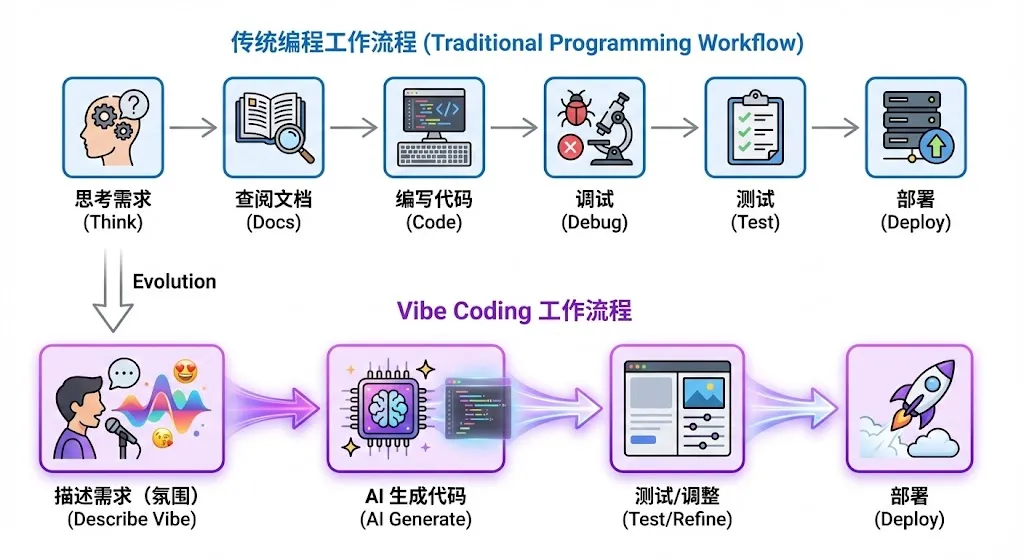
Vibe Coding is a new programming paradigm that emerged in 2024–2025. It does not focus on the specific syntax of code but on the “vibe” — developers describe the functionality and feel they want in natural language, and AI handles the concrete code implementation.
Core definition:
Vibe Coding is a development method in which developers use natural-language prompts to have AI tools generate software code. It shifts the focus from manual coding to an AI-guided way of building.
The Vibe Coding workflow:
4.2 The Origins and Evolution of Vibe Coding
2023: Developers on Reddit joked that they were using ChatGPT to “vibe” features into reality — it was just a meme.
Late 2024: OpenAI founding member Andrej Karpathy took the concept seriously, calling it “the next evolution of AI-native development.”
Early 2025: The Wall Street Journal confirmed that enterprises were beginning to adopt Vibe Coding in real development workflows.
Today: Vibe Coding has gone from a meme to a serious methodology.
4.3 The Vibe Coding Tool Ecosystem
| Tool | Features | Use cases |
|---|---|---|
| Cursor | AI-native code editor, conversational development | Professional development, complex projects |
| GitHub Copilot X | Real-time code suggestions within the IDE | Everyday coding, quick completion |
| Replit Ghostwriter | Multimodal building in the browser | Rapid prototyping, education |
| Claude 3/4 | Long-context understanding | Complex logic, code review |
| ChatGPT-4/4.5 | Natural-language-first | Rapid prototyping, learning |
4.4 Vibe Coding in Practice
Scenario: Creating a to-do app
Traditional approach:
// 需要手动编写所有代码
import React, { useState } from 'react';

function TodoApp() {
  const [todos, setTodos] = useState([]);
  const [input, setInput] = useState('');

  const addTodo = () => {
    if (input.trim()) {
      setTodos([...todos, { id: Date.now(), text: input, done: false }]);
      setInput('');
    }
  };

  // ... 还需要写 toggle、delete、filter 等功能

  return (
    // ... JSX 代码
  );
}
The Vibe Coding way:
用户:"创建一个漂亮的待办事项应用,要有:
- 添加任务的功能
- 标记完成/未完成
- 删除任务
- 按状态筛选(全部/进行中/已完成)
- 使用现代简洁的设计风格
- 数据保存在 localStorage"

AI:(生成完整可运行的代码)

用户:"把完成任务的动画做得更流畅一些,
再加一个进度统计在顶部"

AI:(更新代码)
4.5 The Core Ideas of Vibe Coding
- Design first, prototype fast: describe the feeling and experience you want first, then iterate on the details.
- Conversational debugging: ask “why is this failing?” in natural language instead of spending an hour reading documentation.
- Focus on the product, not the syntax: concentrate your energy on user experience and business logic.
- Iteration speed above all: experiment quickly, validate quickly, adjust quickly.
4.6 The Benefits and Risks of Vibe Coding
Benefits:
- ✅ Greatly increased development speed (a 10x acceleration in the build-test cycle)
- ✅ A lower barrier to programming; non-technical people can also build prototypes
- ✅ Less boilerplate code to write
- ✅ Faster learning and experimentation
Risks and controversy:
- ⚠️ Security vulnerabilities: AI-generated code may contain security risks and requires human review
- ⚠️ Technical debt: rapidly generated code may lack long-term maintainability
- ⚠️ Depth of understanding: developers may not fully understand AI-generated code
- ⚠️ Debugging difficulty: when AI-generated code fails, locating the problem may be harder
Best practices:
“Vibe Coding does not completely replace traditional development; it changes the developer’s role — from writing code line by line to guiding, testing, and optimizing AI-generated output. Developers become mentors to AI, ensuring that the generated code meets project requirements and best practices.”
Chapter 5: Integration and Outlook — A Unified View of the Four-Layer Architecture
5.1 The Evolution of the Four Layers
┌─────────────────────────────────────────────────────────────────┐
│                    第四层:Vibe Coding                           │
│              (人类与 AI 协作的最高形态)                          │
│         开发者描述意图 → AI 生成完整应用 → 迭代优化               │
├─────────────────────────────────────────────────────────────────┤
│                    第三层:Skills & Agentic AI                   │
│              (AI 的行动能力和协作能力)                           │
│    MCP(工具连接) + A2A(Agent 协作) + Function Calling        │
├─────────────────────────────────────────────────────────────────┤
│                    第二层:Context Engineering                   │
│              (AI 的知识环境和记忆系统)                           │
│         RAG + 记忆管理 + 上下文组合 + 外部数据注入                │
├─────────────────────────────────────────────────────────────────┤
│                    第一层:Prompt Engineering                    │
│              (与 AI 对话的基础能力)                              │
│         Zero/Few-Shot + CoT + ReAct + 结构化输出                │
└─────────────────────────────────────────────────────────────────┘
5.2 Dependencies Between the Layers
- Prompt Engineering is the foundation: every layer above depends on communicating effectively with the model.
- Context Engineering is the enhancement: it lets the model access more information and knowledge.
- Skills/Agentic AI is the leap: it moves the model from “speaking” to “acting.”
- Vibe Coding is the convergence: it redefines the human role in the AI era.
5.3 Key Trends for 2025–2026
Trend 1: Protocol Standardization
MCP and A2A are rapidly becoming industry standards, similar to:
- MCP ≈ USB-C: a unified way for AI to connect to tools
- A2A ≈ HTTP: a unified way for AI to communicate with AI
Trend 2: The Rise of the Agent Economy
According to a 2025 global AI survey:
- 29% of enterprises already run Agentic AI in production
- 44% plan to adopt it within the next year
- 88% of early adopters report positive ROI
Trend 3: The Transformation of the Developer’s Role
Developers’ work is shifting from:
编写代码 → 架构设计 + AI 协作 + 代码审查Trend 4: Multi-Agent Collaboration Becomes the Norm
Complex tasks will be completed through collaboration among multiple specialized agents:
- Research agent + writing agent + review agent
- Frontend agent + backend agent + testing agent
- Data analysis agent + visualization agent + reporting agent
5.4 A Learning Path for Beginners
Stage 1: Master Prompt Engineering (1–2 weeks)
- Learn foundational techniques such as zero/few-shot, CoT, and ReAct.
- Practice writing clear, specific prompts.
- Understand the model’s capabilities and limitations.
Stage 2: Understand Context Engineering (2–3 weeks)
- Learn RAG principles and implementation.
- Get to know vector databases (Pinecone, Weaviate, Chroma).
- Practice building a conversational system with memory.
Stage 3: Explore Tool Use & Agents (3–4 weeks)
- Learn function calling.
- Understand the MCP protocol.
- Try building a simple agent.
Stage 4: Practice Vibe Coding (ongoing)
- Use tools such as Cursor and Copilot.
- Start with small projects and build trust gradually.
- Stay critical and review AI-generated code.
5.5 In-Depth Advice for Technical Practitioners
- Understand the protocol layer deeply: MCP and A2A will become infrastructure; understand their design philosophy.
- Pay attention to agent architecture: learn reasoning patterns such as ReAct, ToT, and Reflexion.
- Master orchestration: coordination, state management, and error recovery in multi-agent systems.
- Maintain engineering discipline: no matter how powerful AI becomes, the basic principles of software engineering still apply.
Conclusion: A New Era of Human-AI Collaboration
From Prompt Engineering to Context Engineering, from Tool Use to Vibe Coding, we are witnessing a fundamental transformation in how humans and AI collaborate.
This is not merely the evolution of technology; it is a shift in cognitive paradigms:
- Past: humans told computers “how” to do things (How).
- Present: humans tell AI “what” to do (What).
- Future: humans and AI explore “why” together (Why).
In this new era, the most valuable skills are no longer memorizing the most APIs or writing the most elegant algorithms, but:
- The ability to express intent clearly — knowing what you want.
- The ability to evaluate critically — judging whether AI output is correct.
- The ability to think systematically — understanding how the parts work together.
- The ability to keep learning — adapting to a rapidly changing technological landscape.
As Vibe Coding reveals, future developers may no longer be “writers of code” but “orchestrators of intelligence.” And the layers of Prompt Engineering, Context Engineering, and Skills are the building blocks of this new world.
Whether you are a beginner or a seasoned engineer, now is the best time to enter. Because in this field, everyone is learning, new discoveries are made every day, and every participant has a chance to shape the future.
References
Prompt Engineering:
Context Engineering:
Agentic AI & Protocols:
- Model Context Protocol - Anthropic
- Agent2Agent Protocol - Google
- The Rise of Autonomous AI Agents
Vibe Coding: