Variables and constants
Go is statically typed: variable types are determined at compile time.
Declare variables before using them.
Every variable has a type.
A variable’s type does not change after declaration.
1. Variables
1.1. Ways to declare a variable
// 第一种
var age int (string bool 等)
age = 10
// 第二种
var age = 10
// 第三种
age := 10
1.2. Package-level and local variables
Package-level variables are declared outside functions and can be used within the package.
Local variables are declared inside functions and follow the scope of their enclosing block.
Unused package-level variables are allowed, but unused local variables cause a compilation error.
1.3. Declaring multiple variables
// 第一种
var user1, user2, user3 string
// 第二种
var user1, user2, user3 = "user1", 1, true
// 第三种
var (
	user1 string
	user2 int
	user3 bool
)
1.4. Things to remember
- Declare a variable before use.
- Assignments must be compatible with the variable’s type.
- Names must not conflict in the same declaration scope.
- Short declarations, such as age := 1, cannot be used at package level.
- Variables have default zero values.
var age int //age默认为0
var name string //name默认为""
var isOk bool //isOk默认为false- Unused package-level variables are permitted; unused local variables produce an error.
2. Constants
A constant’s value is specified in its declaration and cannot be changed.
The examples use uppercase constant names to distinguish them; this is a style choice rather than a language requirement.
2.1. Ways to declare a constant
// 第一种
const PI float32 = 3.1415926 //显示定义
const PI = 3.1415926 //隐式定义
// 之后PI不能改变
PI = 3.1415926 //报错
2.2. Grouped declarations
Several forms are available for grouped declarations.
const(
	PI float32 = 3.1415926
	PI2 = 'a'
	PI3 = 3
)
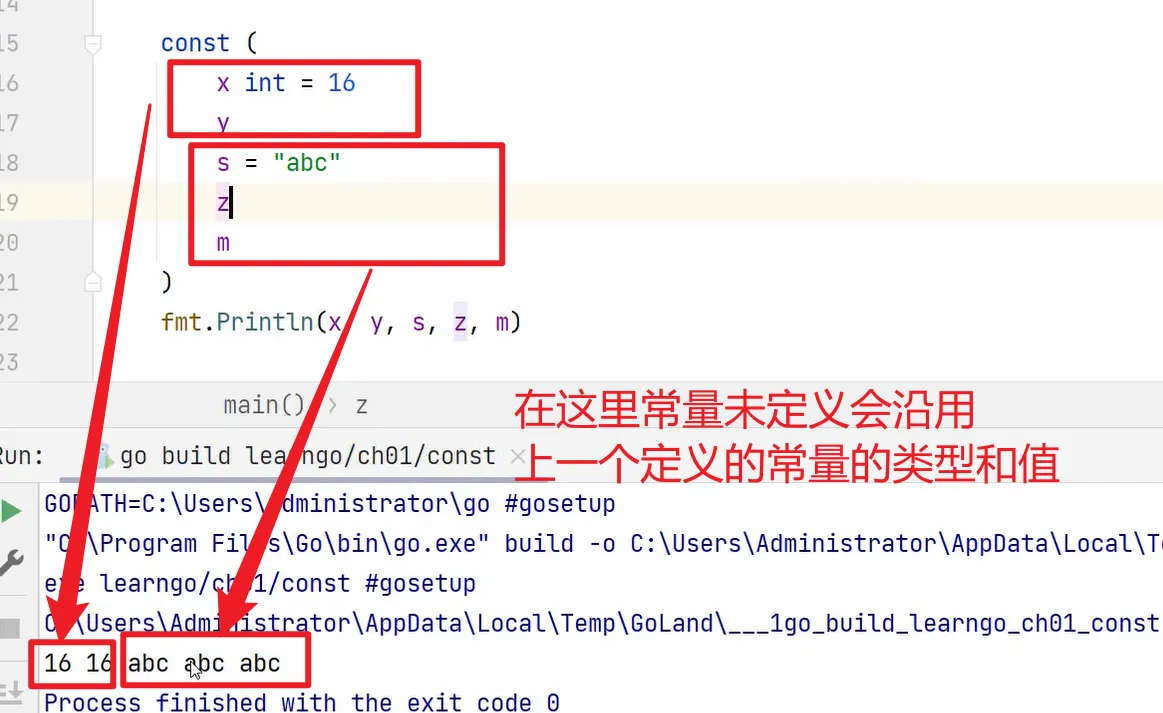
A special case:
cosnt(
    x int  = 1p
    y
    s = 'a'
    z
    m
)
2.3. Things to remember
- Constants can be boolean, numeric, or string values.
- Constants need not be used after declaration.
- An explicitly typed constant must be representable by its specified type.
3、iota
A special identifier for generating successive constant values.
3.1. Using iota
//写法1
const (
    ERR0 = iota
    ERR1 = iota
    ERR2 = iota
    ERR3 = iota
    ERR4 = iota
)
// 输出为:0、1、2、3、4
//写法2
const (
    ERR0 = iota
    ERR1
    ERR2
    ERR3
    ERR4
)
// 输出也为0、1、2、3、4
The counter behavior of iota is shown here:
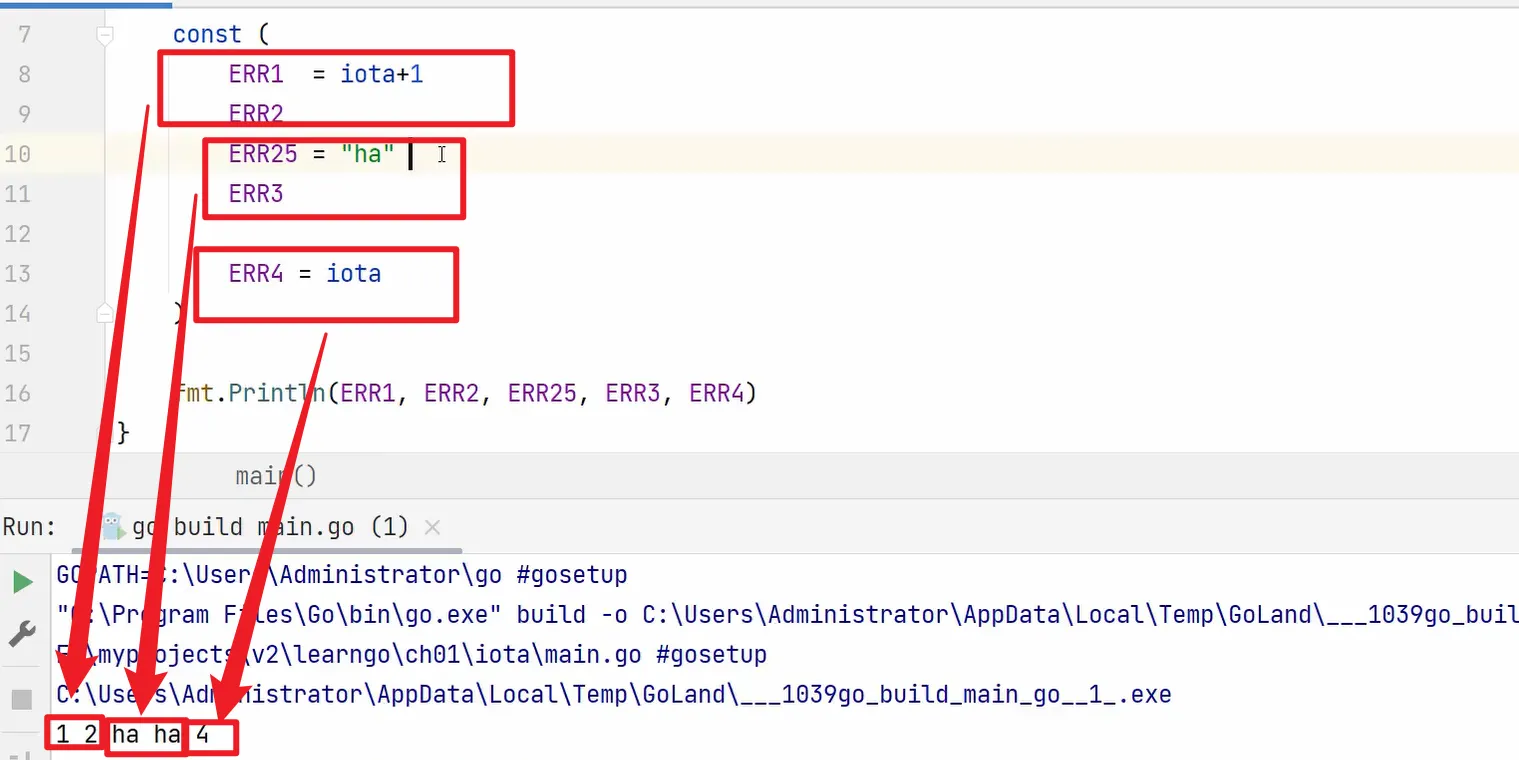
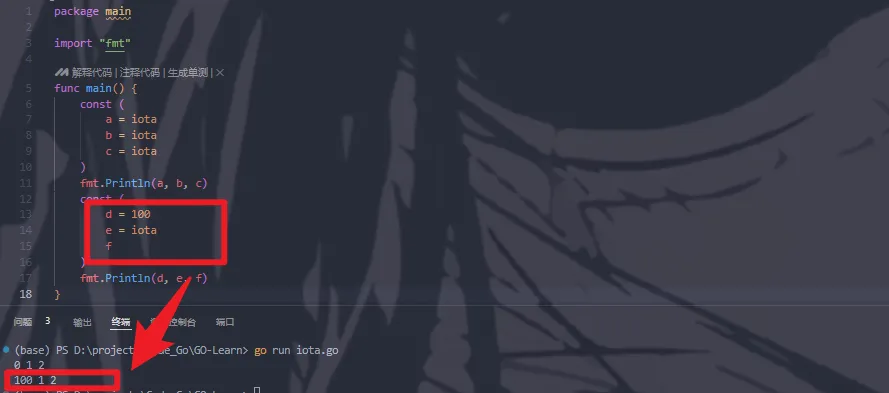
The counter advances for successive constant specifications, regardless of the values assigned.
A new const declaration starts iota at zero again.
3.2. Things to remember
- A changed expression may need to explicitly reintroduce iota.
- iota represents successive untyped integer constants.
- It simplifies groups of related constants.
- Each new const declaration resets the count to zero.
4. The blank identifier
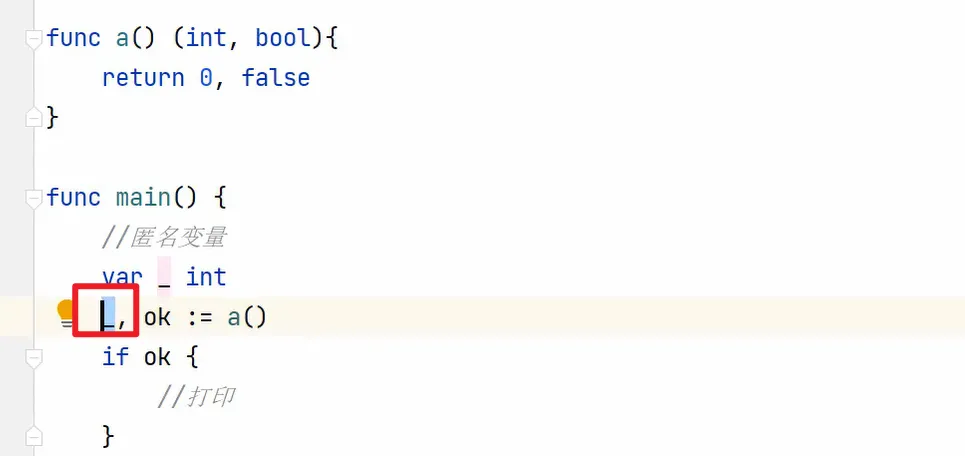
Use an underscore for a value that will be discarded; no unused-variable error is produced.
For example: var _ int = 10
The blank identifier is a placeholder, often used to discard some values from a function with multiple return values. Here is an example:
5. Variable scope
5.1. Package-level variables
Variables declared outside functions are available within the package, subject to Go’s visibility rules.
5.2. Local variables
Variables declared inside a function are limited by their enclosing block.
Pay attention to these boundaries when using a variable.